What actually helps at home
- Position of relief: for most lumbar disc cases, lying on your back with calves on a chair (90/90 position) unloads the disc — simple, free, genuinely useful during flares
- Walking: low-load, cyclic movement is one of the best fluid-exchange pumps a disc has
- McKenzie-style extensions: for the many disc cases that centralize with extension — but only after a professional confirms the direction that helps you
- Breaking up sitting: a lumbar disc under sustained sitting loads measurably more; standing every 30–45 minutes is real decompression in aggregate
- Not smoking: discs have almost no blood supply, and nicotine further starves them — unglamorous but true
Devices: the honest scorecard
Inversion tables provide a general, unmeasured stretch — fine for some healthy backs, not a herniation treatment (see the full comparison). Over-the-door cervical traction units are crude but occasionally useful for neck cases a clinician has approved. Back braces and 'decompression belts' mostly provide compression, not decompression.
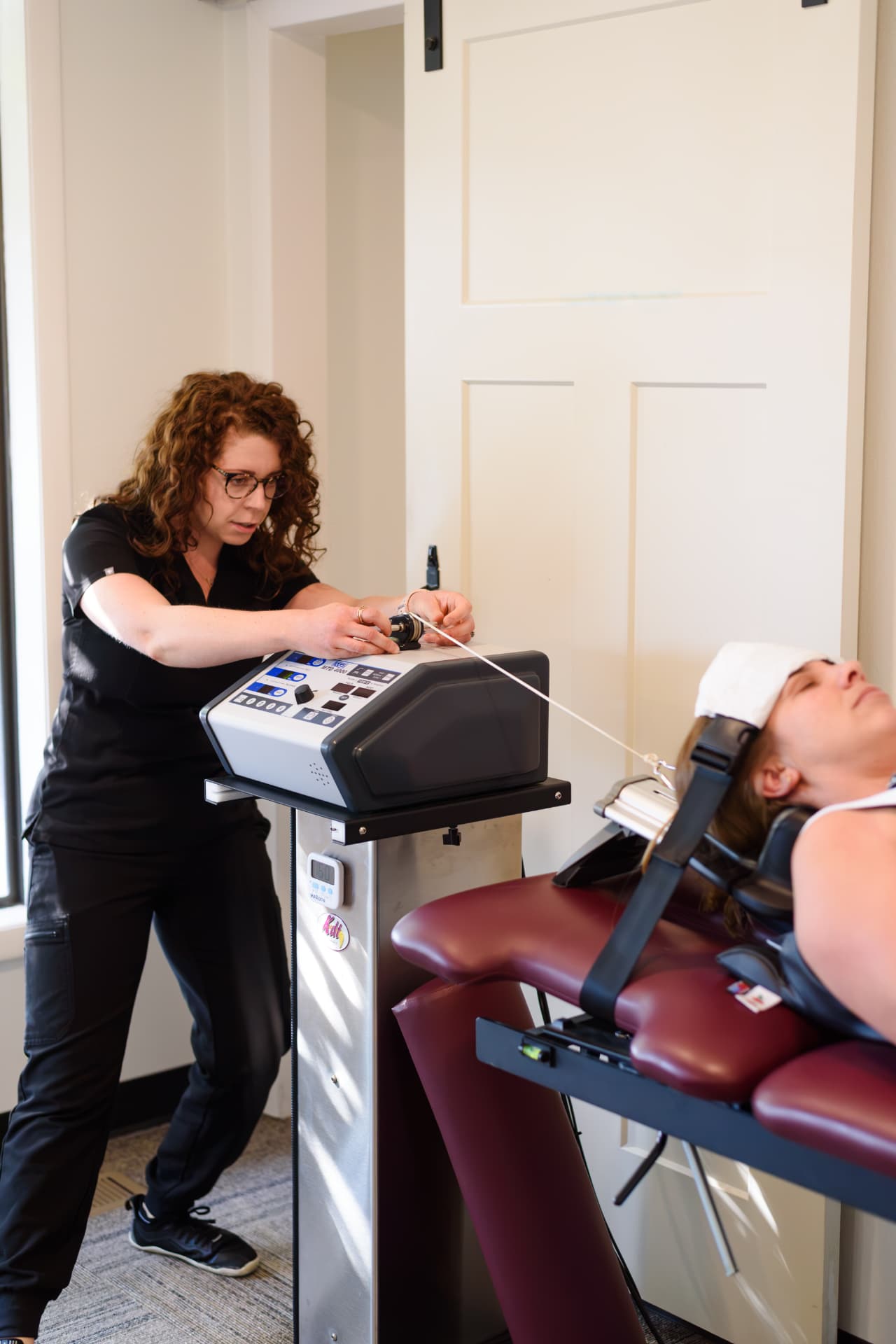
What none of these do is replicate the clinical table's key feature: a measured, cycling force targeted at one spinal level, low enough to avoid triggering the muscle guarding that defeats static stretching.
What to avoid
Aggressive self-traction, hanging from pull-up bars through acute pain, and forceful self-manipulation all load an already-injured disc unpredictably. If a home maneuver reproduces your leg or arm symptoms — pain traveling further from the spine — stop; that's peripheralization, and it means the direction is wrong for you.
The right role for home care
Home strategies are the maintenance crew, not the construction team. For a diagnosed herniation or radiating pain, clinical decompression does the heavy lifting; home care protects the result between sessions and after the plan ends. Any good clinic builds the home program into the plan rather than leaving you to guess.
Common questions
Can I fix a herniated disc at home?
Home care supports healing but can't deliver the targeted, measured unloading that reduces pressure at a specific injured level. For a confirmed herniation with nerve symptoms, professional evaluation is worth it before relying on home methods.
Is hanging from a bar the same as decompression?
No. Hanging applies your upper body weight as unmeasured traction to the whole spine, and grip and muscle guarding limit it further. It can feel good for general stiffness; it is not targeted disc treatment.
What's the single best home habit for disc health?
For most people: stop sitting for long unbroken stretches. Sustained sitting keeps lumbar discs under high load; breaking it up with brief walks or standing does more cumulative good than any gadget.